

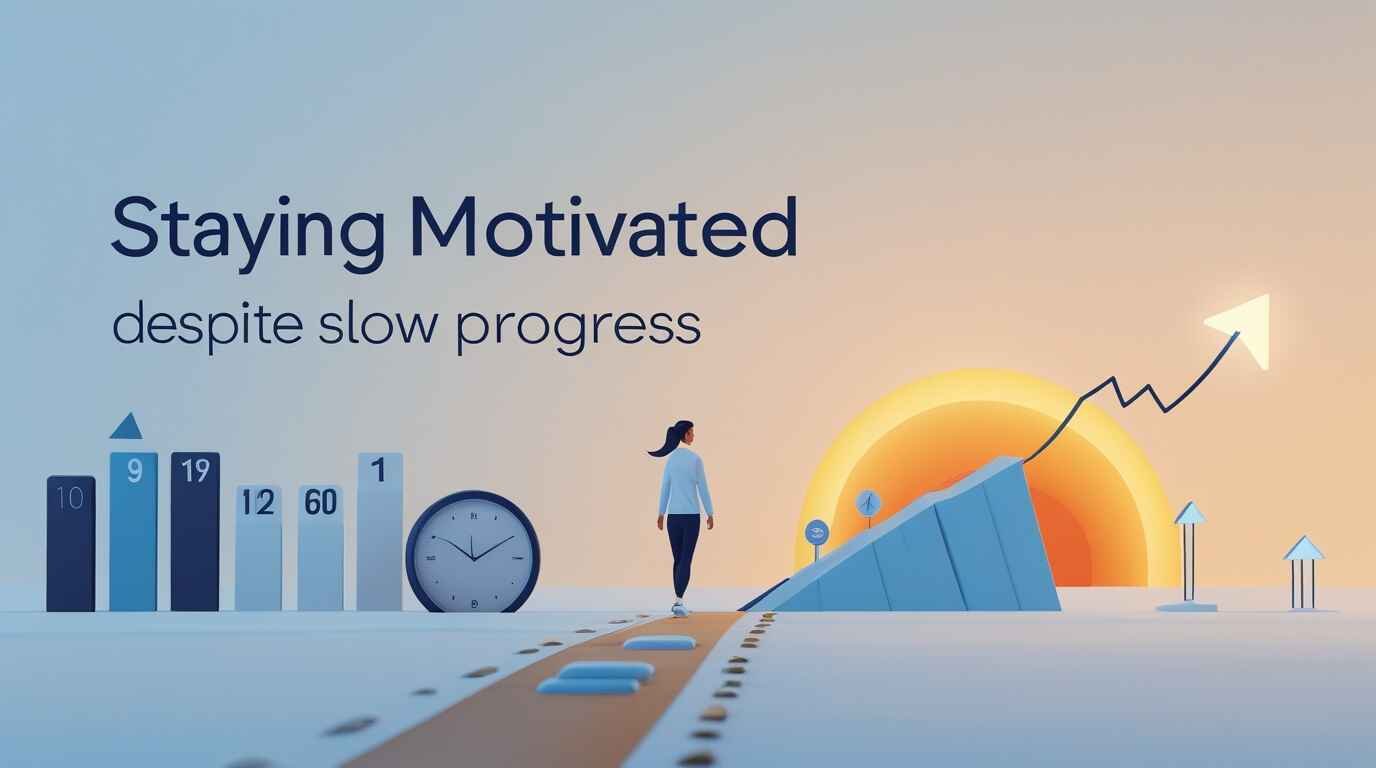
How to Stay Motivated When Progress Feels Slow
It’s the most frustrating feeling in the world, isn't it? You have been putting in the work. You’ve been showing up, eating the salads, writing the pages, or saving the money. You’re doing everything "right." And yet, when you look in the mirror or check your bank account, it looks exactly the same as it did last week. It feels like you are running on a treadmill sweating, panting, and working your heart out, but not actually moving an inch.
This is the danger zone. This is the moment where 90% of people throw in the towel. They think, "Well, I tried, but it’s not working for me," and they quit. But here is the secret that successful people know but rarely talk about: that feeling of stagnation isn't a sign that you are failing. It is actually a sign that you are right in the thick of the process. Progress is rarely a straight line that shoots up to the sky; it is messy, it is slow, and often, it is invisible for a long time before it suddenly becomes obvious. If you are feeling stuck right now, don't panic. You aren't broken, and your plan isn't necessarily flawed. You just need a new way to look at the journey.
The Illusion of Instant Gratification
We live in an era of "now." If you want food, you press a button and it arrives in twenty minutes. If you want to watch a movie, you stream it instantly. We have been conditioned to expect immediate feedback loops. You post a photo, you get a like. You send a text, you get a reply. But meaningful life changes building a career, transforming your body, learning a complex skill do not work on Amazon Prime delivery schedules. They operate on biological and compounding time, which is excruciatingly slow.
The problem is that our brains are wired for immediate rewards. When we don't see a result quickly, our brain signals, "This is a waste of energy. Stop doing it." This is an evolutionary survival mechanism. In the wild, if you expended energy hunting a mammoth and didn't catch it, you starved. But in the modern world, this instinct kills our dreams. You have to intellectually override that primitive voice. You have to understand that the lack of external results does not mean a lack of internal progress. Think of an ice cube sitting in a room that is 20 degrees. You heat the room to 25. The ice doesn't melt. You heat it to 30. Still nothing. You heat it to 31. It looks exactly the same. But at 32 degrees, it begins to melt. All that energy you put in from 20 to 31 degrees wasn't wasted; it was stored. You are likely at 31 degrees right now.
Falling in Love with the Boredom
We often mistake motivation for excitement. We think we need to feel "pumped up" to get work done. But excitement is a terrible fuel source because it burns out fast. Real, long-term success is actually… kind of boring. It’s doing the same reps, eating the same healthy meal, or writing the same code day after day.
The people who succeed aren't the ones who are constantly excited; they are the ones who can tolerate the boredom of consistency. They have learned to detach their effort from their emotions. If you only work when you feel like it, you are an amateur. Professionals show up even when they feel flat, tired, or uninspired. To stay motivated when things are slow, stop looking for the fireworks. Stop waiting for the montage moment where the music swells and everything clicks. Instead, find a quiet satisfaction in the routine itself. Wake up and say, "I am the kind of person who does X every day," regardless of the outcome. When you make the action the win, rather than the result, you become unstoppable because you are in control of the action. You cannot control when the weight comes off, but you can control whether you put on your gym shoes.
Measuring the Invisible Wins
One of the biggest reasons we lose motivation is that we are measuring the wrong things. We look at the "lagging indicators" the scale, the bank balance, the subscriber count. These numbers only change after the work has been done for a long time. If you stare at them every day, you will drive yourself crazy.
Instead, you need to shift your focus to "leading indicators." These are the things you actually do. Did you drink your water today? Did you prospect five new clients? Did you study for 30 minutes? These are the wins you need to celebrate. You need to create a new definition of success that is based on your behavior, not the world’s reaction to your behavior.
Here are some non-obvious signs of progress you should look for when the big numbers aren't moving:
- Ease of Execution: The task feels easier to start than it did a month ago; you aren't fighting yourself as much to get going.
- Recovery Time: When you fail or slip up, you get back on track faster instead of spiraling for weeks.
- Identity Shift: You start saying "I am a runner" instead of "I am trying to run."
- Knowledge Retention: You notice you understand the jargon or the concepts of your new skill without having to Google them.
- Mental Resilience: You can handle the boredom without reaching for your phone every two minutes.
The Toxic Trap of Comparison
It is 2026, and social media is still the absolute thief of joy. You are struggling through your "Chapter 4" the messy part where you are figuring things out and you open Instagram to see someone else’s "Chapter 20." You see their finished product, their perfect body, or their IPO. You don't see the years of doubt, the failed launches, or the 5:00 AM wake-up calls that got them there.
Comparing your behind-the-scenes footage with someone else’s highlight reel is a recipe for depression. It makes your progress feel even slower because their success looks instant (even though it wasn't). You have to put blinders on. Imagine you are a horse in a race. If you look sideways at the other horses, you stumble. You lose speed. You have to look forward at your own track. If you must compare, compare yourself to who you were last month. Are you better than that version of you? If yes, then you are winning. If no, then adjust your strategy. But do not measure your pace against a stranger on the internet who has a completely different set of circumstances, genetics, and resources than you do.
Visualizing the Cost of Quitting
When the going gets tough, we often fantasize about quitting. We think about how nice it would be to just sit on the couch, eat the pizza, and stop trying so hard. It feels like relief. But that relief is a lie. It is temporary.
To stay motivated, you need to play the tape forward. Ask yourself: "If I quit today, what will my life look like in a year?" Will you be happier? Or will you be in the exact same spot you are now, filled with regret and wishing you had kept going? Usually, the pain of discipline is far less than the pain of regret. Discipline weighs ounces; regret weighs tons. Use "negative visualization" to your advantage. vivid imagine the frustration of starting over from zero in six months. Remind yourself that time is going to pass anyway. The next year is going to happen whether you work on your goals or not. You can arrive at 2027 having made slow progress, or you can arrive there having made none. The time will pass regardless, so you might as well have something to show for it.
The Power of the "Micro-Pivot"
Sometimes, progress feels slow because we are actually banging our heads against a wall. We are trying to force a strategy that isn't working. There is a fine line between perseverance and stubbornness. If you have been doing the exact same thing for months with zero results, it might be time for a "micro-pivot."
This doesn't mean changing the goal; it means changing the method. If you are trying to lose weight and running isn't shifting the scale, maybe try lifting weights. If your blog posts aren't getting read, don't stop writing, but maybe try a different headline style or a new platform. Treat your life like a science experiment. You are the scientist. The lack of results is just data. It’s the universe telling you, "Hey, try tweaking the variable." Don't take it personally. Don't let it be a judgment on your character. Just look at the data, adjust the plan by 10%, and keep moving. Often, a tiny adjustment unlocks the door that you’ve been pounding on for weeks.
Conclusion: The Compound Effect is Real
The most powerful force in the universe isn't gravity; it’s compound interest. And it applies to everything, not just money. Small, seemingly insignificant actions, repeated consistently over time, produce radical results. But the curve of compounding is flat for a very long time before it spikes.
You are currently on the flat part of the curve. It feels like nothing is happening, but you are building momentum. You are laying the foundation of a skyscraper. Digging the hole for the foundation takes a long time, and nobody sees it. It looks like a hole in the ground. But once the foundation is set, the building rises into the skyline incredibly fast. You are in the digging phase. Do not drop the shovel. Trust the process, trust the math of compounding, and just keep showing up. One day, you will look back at this "slow" period and realize it was actually the most important part of your entire journey.
Frequently Asked Questions (FAQ)
1. How do I distinguish between "slow progress" and "no progress"?
This is a tricky one. If you have been consistent for at least 3 to 6 months and see absolutely zero change in your primary or secondary metrics, you might have "no progress." However, usually, there are small signs. Check your "leading indicators" (your habits). If you are doing the work but getting no results for a long time, it’s time to audit your strategy or get an expert opinion, rather than just waiting longer.
2. Should I lower my goals if I'm discouraged?
Not necessarily your goals, but perhaps your timelines. We often overestimate what we can do in a month and underestimate what we can do in a year. Keep the big goal, but break it down into much smaller, bite-sized daily targets. Making the daily target easier to hit (e.g., "write 100 words" instead of "write 1000") can rebuild your confidence and momentum.
3. How can I get my friends/family to support me when I'm struggling?
Be vulnerable with them. Instead of acting like you have it all together, tell them, "Hey, I'm actually in a tough spot with this project and feeling a bit down. I don't need you to fix it, but some encouragement would really help right now." Most people want to help; they just don't know you need it. If they are toxic or unsupportive, you may need to distance yourself temporarily to protect your mindset.
4. Is it okay to take a break when I feel stuck?
Yes, absolutely. Sometimes "slow progress" is actually burnout in disguise. A strategic break (like a weekend completely off, or a week of "maintenance mode") can reset your dopamine receptors and lower your cortisol. You often come back from a break with a fresh perspective and renewed energy. Just make sure the break has a defined end date so it doesn't turn into quitting.
5. How do I stop obsessing over the end result?
Focus on the "system." Fall in love with the daily ritual. If you are a writer, love the act of making coffee and sitting at the keyboard. If you are an athlete, love the feeling of the stretch. When you derive joy from the doing rather than the getting, the timeline stops mattering as much because you are already winning every day you show up.